Your First Test Match: Follow the Session, Not Every Ball
Follow a first Test match by tracking score, wickets, and the changing contest between batters and bowlers, without trying to remember every delivery.
A first Test match is easier to follow when you track the score, wickets, and the contest between batters and bowlers rather than trying to remember every delivery. Start with what has changed since you last looked: a new batter, a different bowler, or a shift in how the pair at the crease is playing.
What should you check when you tune in?
Find the innings, score, and wickets lost on the scoreboard. Then identify the two batters and the current bowlers. These details tell you who is under immediate pressure and give you a reference point for following the next passage of play.
Look at visible conditions, too. A damp outfield, a marked pitch, or changing light may help explain decisions, but none predicts what will happen next. Treat them as context rather than a forecast.
Ask what each side might want from the next passage. The batting side could be trying to settle a new player, while the bowling side may be looking for a wicket or seeking to limit easy scoring.
How can you read what is happening at the crease?
Look for repeated patterns, not a single dramatic delivery. Notice where a bowler pitches the ball, whether it moves in the air or off the pitch, and how the batter responds. A sequence of leaves, defensive strokes, or attacking shots can show what the batter is judging as safe or risky.
Compare that pattern with the field. A close fielder may be positioned for an edge or a hurried stroke; a boundary fielder may be placed to discourage a particular shot. These positions are clues to the captain’s plan, not a complete explanation of it.
Consider how runs are coming. Singles can keep the strike moving, while boundaries in bursts may follow a batter waiting for a delivery to attack. Read either pattern alongside wickets and the score rather than treating it as good or bad on its own.
After a dismissal, look back at what preceded it. A change in length, angle, or pace may have mattered; so may pressure from a quiet spell or a risky shot. You do not need to identify one certain cause to see how the wicket changes the contest.
How do you catch up after missing play?
Check the current score, the latest wicket, and who is at the crease. A scorecard gives the basic state of play; commentary or a replay can explain how a dismissal happened or when a bowling change was made.
Imagine you pause with a settled pair batting, then return to find a new batter, a close fielder, and fewer runs coming. The concrete change is that a wicket has brought a new player into a more pressing situation. You can follow what happens next without reconstructing every over you missed.
Use a replay to clarify an event that affects your understanding, such as a dismissal or an appeal. For the rest, the current score and the players’ roles are usually enough to rejoin the match.
What questions help you follow your first Test match?
Why are there breaks during a Test match?
Scheduled breaks divide the day into sessions and give players time to rest. They also give you a convenient moment to check the score and identify what has changed since the previous passage.
What is a partnership in cricket?
A partnership is the period when two batters share the crease, ending when one is dismissed. The pair may stabilize the innings, keep it moving, or leave the incoming batter to face a new challenge.
Should I follow the score or the bowling?
Use the score to understand the stakes and the bowling to see how the contest is being shaped. A quiet spell may build pressure, while a burst of runs may matter less if wickets are falling at the same time.
How can I tell which side had the better session?
Compare each side’s immediate aim with what happened: the batting side’s runs and wickets lost, and the bowling side’s wickets or restraint. If the results are mixed, describe the gains and setbacks rather than forcing a simple verdict.
How can a short note help you follow a Test match?
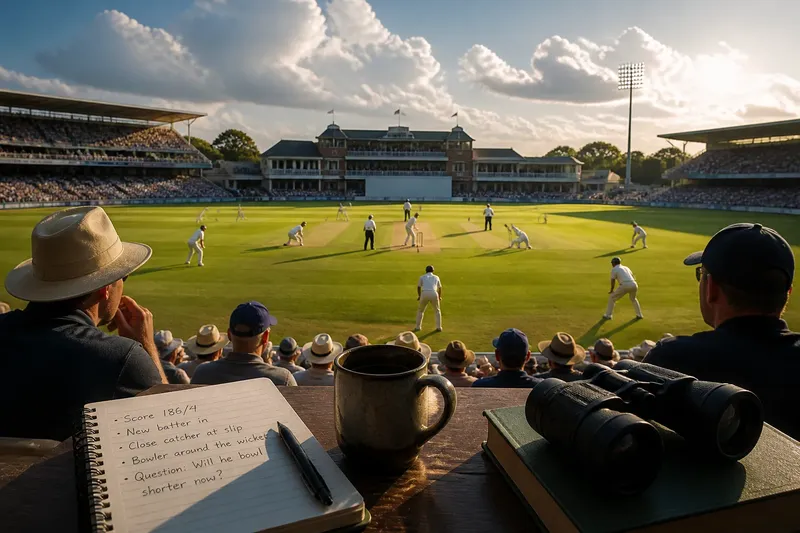
Write down the score and wickets, one notable change, and a question you want to check later. For instance, note that a new batter is facing deliveries outside off stump and that the field has a close catcher. This records visible details without turning them into a prediction.
When play resumes, check whether the bowler, field, or batter’s shot choices have changed. If none has, that is still a useful observation: the teams may be continuing with the same approach.
For a first Test match, use the score to keep your bearings and watch how the players respond to the situation in front of them. A clear sense of who is batting, who is bowling, and what has just changed makes even a quiet passage easier to follow.