Test, One-Day or T20: How Format Shapes a Cricket Innings
Compare Test, One-Day, and T20 innings to see how overs, match time, wickets, and targets shape a batting plan in each cricket format.
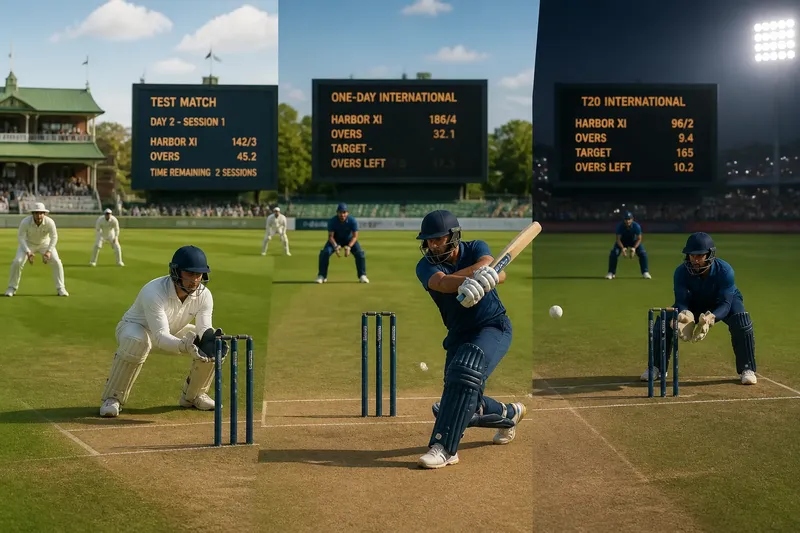
Test, One-Day, and T20 cricket give a batting side different limits on time, and those limits shape how an innings develops. In a Test, the match clock and the prospect of a declaration matter; in limited-overs cricket, a set number of overs makes each unused delivery unavailable later.
Imagine a hypothetical Harbor XI batting first with a steady opener, an attacking batter, and a capable middle order. The pitch is sound, but its conditions and the bowlers’ plans can still change the choices available. The same starting lineup faces a different problem in each format.
What ends an innings in each format?
An innings is a team’s turn to bat. An over consists of six valid deliveries from one bowler, after which another bowler takes over. In One-Day and T20 cricket, the innings ends when the overs are used or an earlier ending condition applies.
A limited-overs innings can also end when the batting team loses all but one of its batters, or when its captain declares in a competition that permits declarations. In Test cricket, an innings can end when the batting side is all out, its captain declares or forfeits it under the Laws, or the match’s time or innings limit is reached. Competition playing conditions can set further limits, so a match’s rules matter alongside the format.
Test matches usually allow each team two innings, though a side may not need its second turn if the match ends sooner under the applicable conditions. A Test can finish in a win, a draw, or a tie. By contrast, limited-overs matches generally have each side bat once, and the second team pursues a target set by the first.
Why does a Test innings depend on the match clock?
A Test has no ordinary fixed quota of overs for each innings. Batters can take time to assess movement, leave balls outside the stumps, and defend deliveries that threaten the wicket, but the match schedule still limits how long the teams have to complete their innings.
Say Harbor XI’s opener faces early movement and a field set to cut off easy scoring. The opener leaves balls outside the hitting area and defends the ones aimed at the stumps; the observable result is a slower start that may preserve wickets while the batter learns the conditions. If the match clock is running short, however, that same pace may leave too little time for the team to force a result.
Later, the captain must consider whether more runs are worth the time they consume. A declaration ends the team’s innings before all its batters are out, giving the opposition a chance to bat; declaring too soon, however, may leave the bowling side too few runs to defend. The decision depends on the score, time remaining, and match situation, not on a fixed stage of the day.
In a Test, ask whether time at the crease is building a useful total or reducing the chance to pursue a result.
Why does a One-Day innings need a measured change of pace?
A One-Day innings has a finite over allowance, usually fifty overs in an international match, subject to the competition’s playing conditions. The batting side needs to keep scoring through the middle of the innings while retaining enough batters to make use of the closing overs.
Imagine Harbor XI’s opener and attacking batter have settled in, but the bowlers are keeping the ball away from their preferred hitting areas. They take singles into gaps and turn safe shots into twos; the scoreboard keeps moving without requiring a boundary attempt on every delivery. If a bowler offers width, they can then judge whether a boundary shot is worth the risk.
As the innings nears its end, unused overs cannot be carried forward. Batters often seek more boundaries, but a wicket can leave a less settled batter at the crease and reduce the side’s options. The useful question is not simply whether to attack, but which batter and delivery offer the best chance to score without exposing the innings unnecessarily.
A One-Day innings works best when the side avoids leaving all its scoring pressure to the final overs.
Why does T20 call for scoring intent from the start?
A T20 innings is limited to twenty overs, subject to competition conditions. With less time to recover from a quiet passage than in a One-Day match, batters usually look to score from the start while still choosing which deliveries to attack.
Say Harbor XI’s opener sees a short ball outside a comfortable hitting area and declines to force a shot. The next delivery is on the pads, so the batter works it into a gap and runs; the result is a scoring opportunity taken without treating every ball as a boundary chance. If the bowler changes length, the batter reassesses rather than repeating the same response.
A batting order can also be adjusted to match a moment: a team may send in a batter suited to a particular bowler or phase. That choice trades the usual batting order for a specific skill, and it only helps if the incoming batter can address the situation. Late in the innings, boundary attempts may become more valuable, while wickets in hand still determine how much risk the team can absorb.
In T20, urgency means looking for scoring options early, not swinging at every delivery.
What should you watch when a batting plan changes?
Four details explain most changes in a team’s approach. Use them together rather than treating a scoring rate as a complete description of the innings.
- Overs or match time: If a limited-overs side has few overs left, expect greater urgency; if a Test has ample time, a batter may have room to assess conditions. If the clock is tight in a Test, watch for quicker scoring or a declaration.
- Wickets in hand: If several established batters remain, a side may accept more risk; if few remain, it may protect the batters capable of extending the innings. Check who is waiting to bat, not only the number of wickets lost.
- Setting or chasing: If the team is chasing, compare its progress with the target; if it is batting first, notice how it balances building a total against using the remaining overs. A chase can change pace as the required scoring rate shifts.
- Bowling and field: If a bowler offers a scoring area or the field leaves a gap, expect the batter to consider using it; if the ball and field make a shot difficult, a single or a defensive choice may be wiser. The format changes the time pressure, not the delivery itself.
For example, a fast burst of runs with several wickets lost leaves a different problem from the same scoring burst with the top order intact. The runs matter, but so do the batters left and the time available.
Which questions help explain an innings?
Why can a Test innings last more than one day?
Test innings have no ordinary fixed over quota, so they may continue across days while the match schedule allows. They can end through conditions such as the side being all out, a declaration, or a match limit specified by the Laws and playing conditions.
Why do One-Day batters build before attacking more often?
A One-Day side has a limited supply of overs and needs to make use of them while keeping enough batters available for a later push. Building a steady scoring base can help it avoid leaving too much work for the end.
Does T20 mean every delivery should be attacked?
No. A difficult shot can cost a wicket, while a single into a gap can keep the innings moving. Batters judge the delivery, field, and remaining wickets even when the short format makes scoring intent urgent.
What is the difference between a declaration and a forfeiture?
A declaration is a captain’s decision to end the team’s innings while its batters remain. A forfeiture is the captain’s decision to give up an innings before it begins; both apply under the Laws, but they describe different decisions.
How does the same batting lineup face different problems?
Harbor XI’s steady opener, attacking batter, and middle order do not need a new identity in each format; the limits around them change. The Test version weighs scoring against match time, the One-Day version must distribute its work across a fixed over allowance, and the T20 version has less room for a quiet start.
When you watch Test, One-Day, or T20 cricket, note the time available, the batters still to come, and whether the side is setting or chasing a target. Those details make a change in tempo easier to read. A useful final check is to look at the next bowler and field as well: they can explain why a batter chose one scoring option over another.